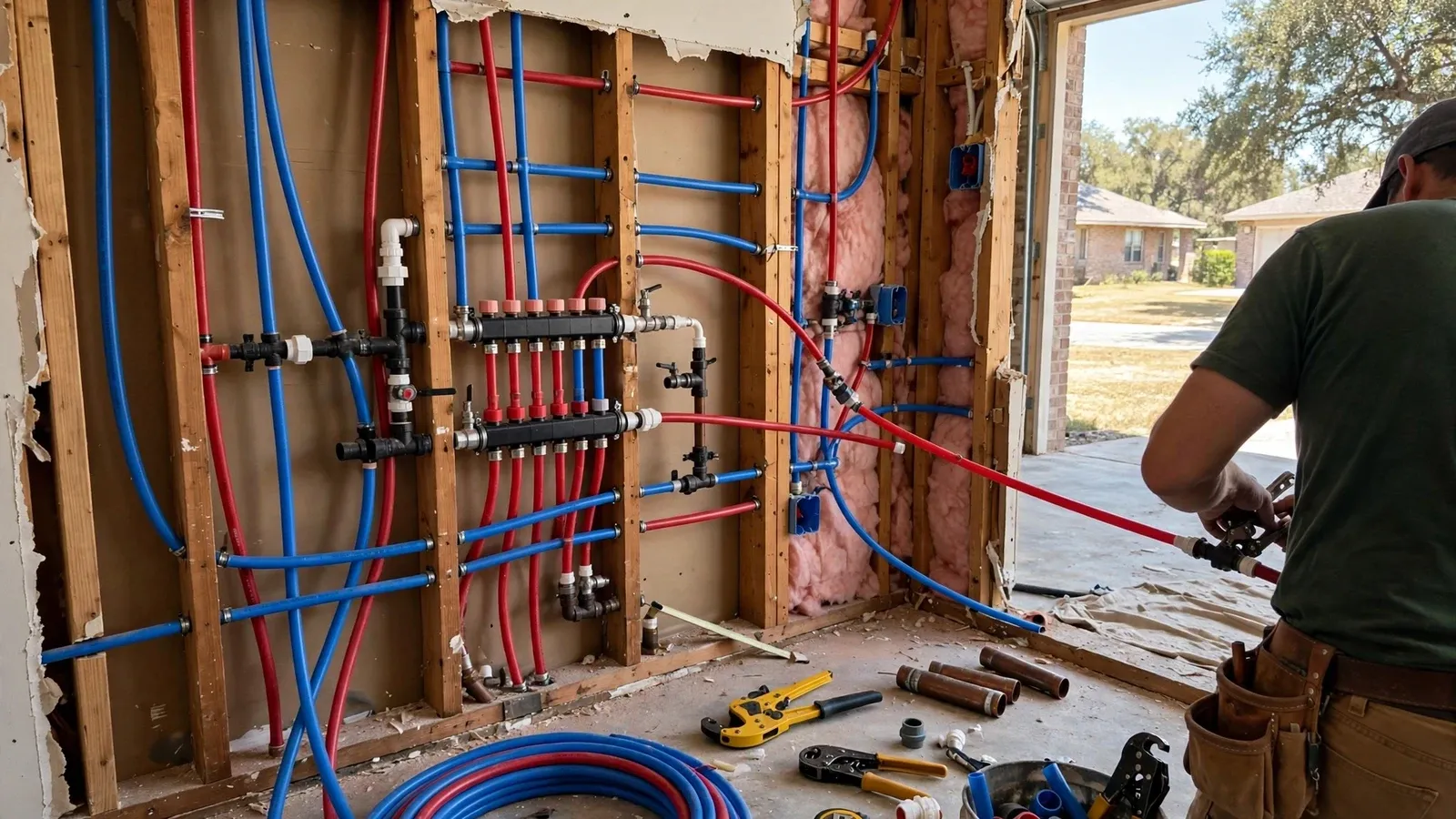
Repiping replaces the supply lines that carry water through your house
Repiping means replacing the pressurized supply lines, the pipes that bring water to faucets, showers and appliances. It does not usually involve the drains. People consider it after repeated pinhole leaks, rusty or discolored water, falling water pressure or the discovery that the house has a pipe material known to fail.
This is a big decision, so we start with a diagnosis, not a sales pitch. Often a repair is enough. When it is not, a well-planned repipe stops a cycle of leaks and drywall repairs. If a pipe is leaking right now, see burst pipe repair first.
What different supply pipe materials tend to do
The pipe in the wall tells you what to watch for.
| Material | Found in | Common issue |
|---|---|---|
| Galvanized steel. | Homes from the early post war years into the 1960s. | Interior rust narrows the pipe, pressure drops, water turns brown. |
| Copper. | Homes from the 1960s on. | Pinholes in thin-wall pipe, solder joint failures. |
| Polybutylene (gray plastic). | Some homes from the late 1970s to the mid 1990s. | Fittings and the pipe itself can fail suddenly. |
| CPVC. | Homes from the 1990s on. | Becomes brittle with age and heat. |
| PEX. | Homes from the late 1990s on. | Generally durable, fitting and installation quality matter. |
These are general patterns. A plumber confirms the material by looking at it.
Pipes leaking more than once?
Call and describe the history. A plumber can tell you whether repair or repipe fits.
How a repipe is planned and done
A repipe is a major project, and a good plan keeps the disruption small.
- 1
Assess the pipes and the house.
The plumber inspects visible lines, tests pressure and identifies the material, access and number of fixtures.
- 2
Set the scope and price.
You hear whether a partial repipe makes sense or the whole house, with a clear price and a plan for the wall openings.
- 3
Install the new lines.
New supply lines are run with minimal wall openings where possible, and fixtures are reconnected.
- 4
Test, restore access and clean up.
The system is pressure tested before any wall openings are closed. Patching drywall is a separate trade the plumber can coordinate or leave to you.
A repipe often requires a permit and an inspection. Ask the plumber how this is handled for your address.
When it makes sense to stop patching
Not every leak means the system is done.
Spot repair fits when
- One leak in an otherwise good system.
- A localized fitting failure.
- The pipe material is durable and the house is newer.
- Pressure and water color are normal.
Repiping fits when
- Pinholes keep appearing in different places.
- The pipe is a known failure-prone type.
- Pressure is low from interior corrosion.
- You are opening walls for a remodel anyway.
Roy's housing eras and the pipes inside them
Roy grew from about 800 people in the early 1940s to about 24,600 by 1990, according to the Utah History Encyclopedia. That is several waves of construction, and each wave used the pipe that was standard at the time. A galvanized supply line from the 1950s is in a very different state than copper from the 1970s or PEX from the 2000s.
The city's water plan reports delivery pressure of 60 to 90 psi and notes that its own mains are mostly PVC because of the area's corrosive soil. Inside your house the corrosion is a different process, driven by water chemistry and pipe age, but the pressure matters for both. A regulator extends the life of whatever pipe you have.
Getting ready for a repipe
Planning ahead makes the project smoother.
- Get a clear price and scope in writing.
- Ask how many days the water will be off.
- Plan for temporary water arrangements.
- Clear access to walls and utility areas.
- Ask who handles drywall patching and paint.
What decides the price of a repipe
Insurance usually does not pay for replacing aging pipe, but may cover damage from a sudden failure. Ask your insurer.
Before you commit to a repipe
Not every leak means the pipes are done, so a leak check is a sensible first step. A fresh split is a burst pipe matter, and a remodel that opens walls anyway is a good time to talk to us about plumbing installation. We plan repipes for homes in Ogden and Roy.
Questions about repiping
Repeated pinhole leaks, brown water, falling pressure or a known problem pipe material are the main signs. A plumber can confirm after an inspection.
It depends on the size of the house and access. The plumber gives a time estimate with the price. Planning for the water to be off for part of the work is wise.
Some wall openings are normal. Experienced plumbers keep them small and place them where they are easiest to patch. You get the plan before work starts.
It has a history of failure, especially at fittings, and many homeowners replace it as a precaution. The plumber can identify it and explain your options. See leak detection if you suspect a hidden leak.