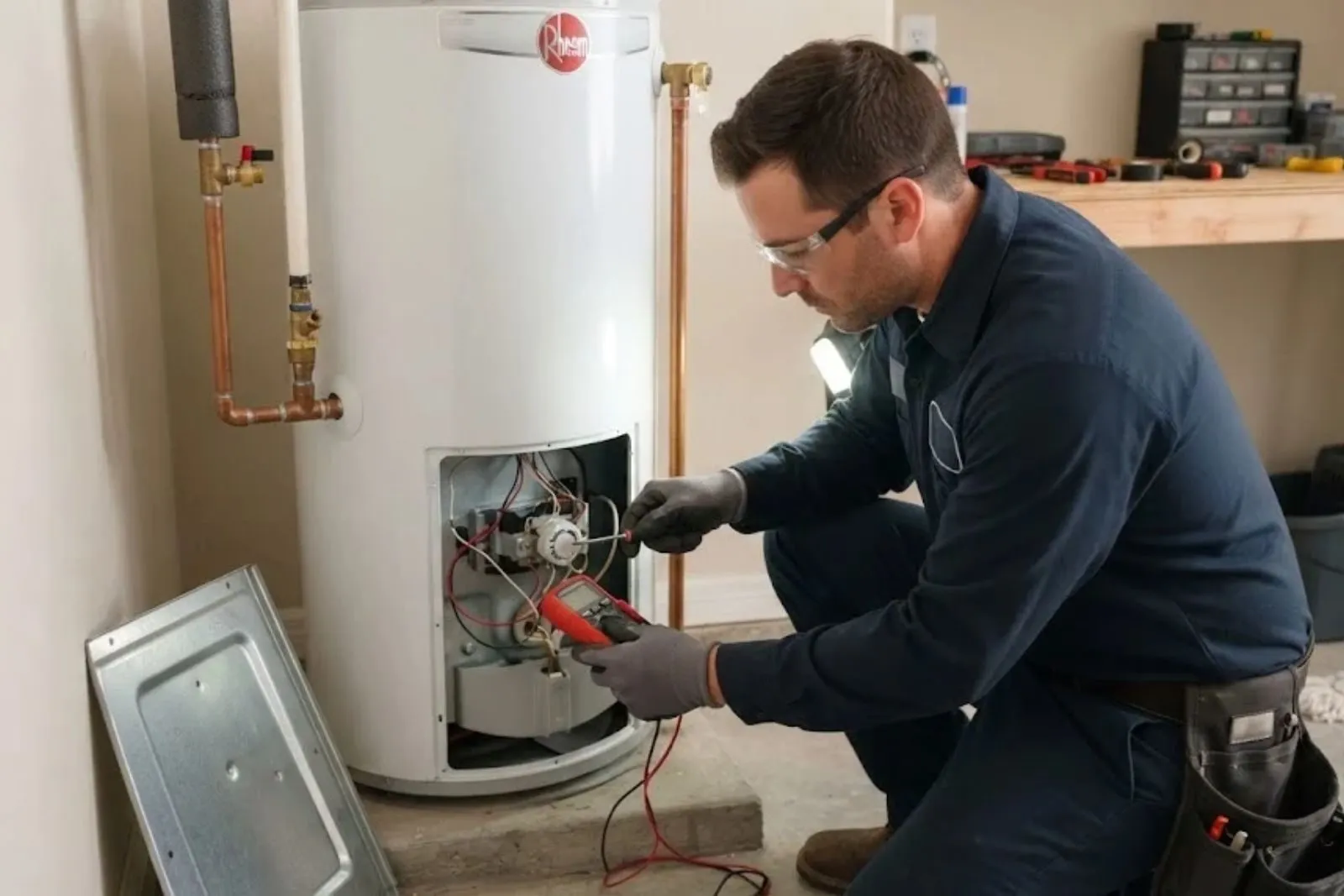
No hot water or a leaking tank needs attention now
A water heater that leaks is more urgent than one that is cold. If water is pooling around the base, turn off the cold supply valve above the tank, switch the gas valve to pilot or the breaker off, and call. Slow weeps from a fitting can sometimes be repaired, but water from the tank body means the tank has failed.
If the heater simply stopped making hot water, you have a little more time. Check that the breaker has not tripped or the pilot has not gone out, and call us if it persists. Our 24/7 line takes both kinds of call.
What the symptom usually means
These are common patterns, not a diagnosis. The plumber confirms the cause with tests before recommending any repair.
| Symptom | Gas tank | Electric tank | Usually worth checking |
|---|---|---|---|
| No hot water at all. | Pilot out, thermocouple, gas supply. | Breaker, high-limit reset, upper element. | Power or fuel first. |
| Water only lukewarm. | Dip tube or low flame. | Lower element or thermostat. | Heating components. |
| Rumbling or popping noises. | Sediment baked on the tank bottom. | Sediment over the lower element. | Flushing and tank age. |
| Water at the base. | Fitting leak or failed tank. | Fitting leak or failed tank. | Source of the water, then replacement if the tank is leaking. |
A repair makes sense when the tank is sound. It rarely makes sense on a tank that is leaking from the shell.
How a water heater repair visit runs
The visit is built so you leave knowing what failed and what your options are.
- 1
Confirm the symptom.
The plumber asks when the problem started and checks the unit, the venting or power and the temperature setting.
- 2
Test, then explain.
Burner, thermocouple, elements and thermostat are tested rather than guessed at. You hear what failed in plain language.
- 3
Give a clear price.
The repair price and, if relevant, the replacement price are both stated, so you can compare them before deciding.
- 4
Repair and verify.
After the repair the plumber confirms hot water at a faucet and checks for leaks and exhaust issues.
Cold shower or wet floor?
Shut off the water to the tank and call. Dispatch is open 24/7.
How to decide whether the tank is worth fixing
Age and condition matter more than the single part that failed.
Repair makes sense when
- The tank is not leaking from the shell.
- The failed part is a thermostat, element, valve or pilot assembly.
- The heater is within the middle of its expected service life.
- Everything else on the unit is in good shape.
Replace makes sense when
- Water is escaping from the tank body.
- Heavy rust shows at the base or fittings.
- The heater is near the end of its life and has had other repairs.
- You want to change size or type, as with a tankless unit.
The nameplate on the side of the tank shows the manufacture date, usually in a serial number code. Have it ready when you call.
Hard water and pressure in Roy water heaters
Roy blends water from its own wells with treated water from the Weber Basin Water Conservancy District. Weber Basin reports hardness of 10 to 18 grains per gallon for its supply, which is hard water. Scale from hard water settles on elements and the tank bottom, so heaters can run noisy and slow to recover as they age.
Roy's water plan also notes delivery pressure between 60 and 90 psi. High pressure puts extra strain on tank seams, relief valves and fittings. A pressure gauge on an outdoor spigot tells you where you stand, and a plumber can fit a regulator or an expansion tank if the number is high.
Safety checklist: what to do at the heater
A few quick checks prevent the problems that turn a repair into an emergency.
- Look for rust or water at the base and fittings.
- Check that the temperature and pressure relief valve has a discharge pipe pointed toward the floor.
- Keep storage and flammables away from gas heaters.
- Confirm exhaust venting is connected on gas units.
- Do not tamper with a relief valve that drips, since it signals a pressure or temperature issue worth diagnosing.
If you smell gas, leave the building and call the gas utility or 911 before calling us.
What decides the price of a water heater repair
Insurance may cover sudden water damage from a failed heater, but rarely the heater itself. Ask your insurer before repairs.
What not to do
- Do not remove or plug the temperature and pressure relief valve.
- Do not relight a gas pilot if you smell gas.
- Do not drain a hot tank into a closed space.
- Do not tamper with the burner or vent on a gas unit.
- Call a plumber if the same breaker or pilot problem repeats.
Related help around the water heater
A heater that keeps failing may be better replaced, and our replacement page explains how that decision is made. If scale is the pattern, softener sizing helps, and homeowners in Clearfield ask about this often. Heating questions about an unusually high bill belong with leak detection.
Questions about water heater repair
It can wait a few hours if the tank is not leaking. A leaking tank, a gas smell or a tripping breaker is urgent. Call the 24/7 line and describe it.
Flushing helps in hard water areas, but a heater that has never been flushed may have heavy sediment. Ask the plumber to check first, so a flush does not loosen a valve that was holding.
Rumbling or popping usually comes from sediment on the tank bottom boiling under the burner or element. It is common in hard water and is worth addressing before the tank wears out.
Yes. Tankless units have different failure points such as scale in the heat exchanger and error codes. See our tankless water heater page.