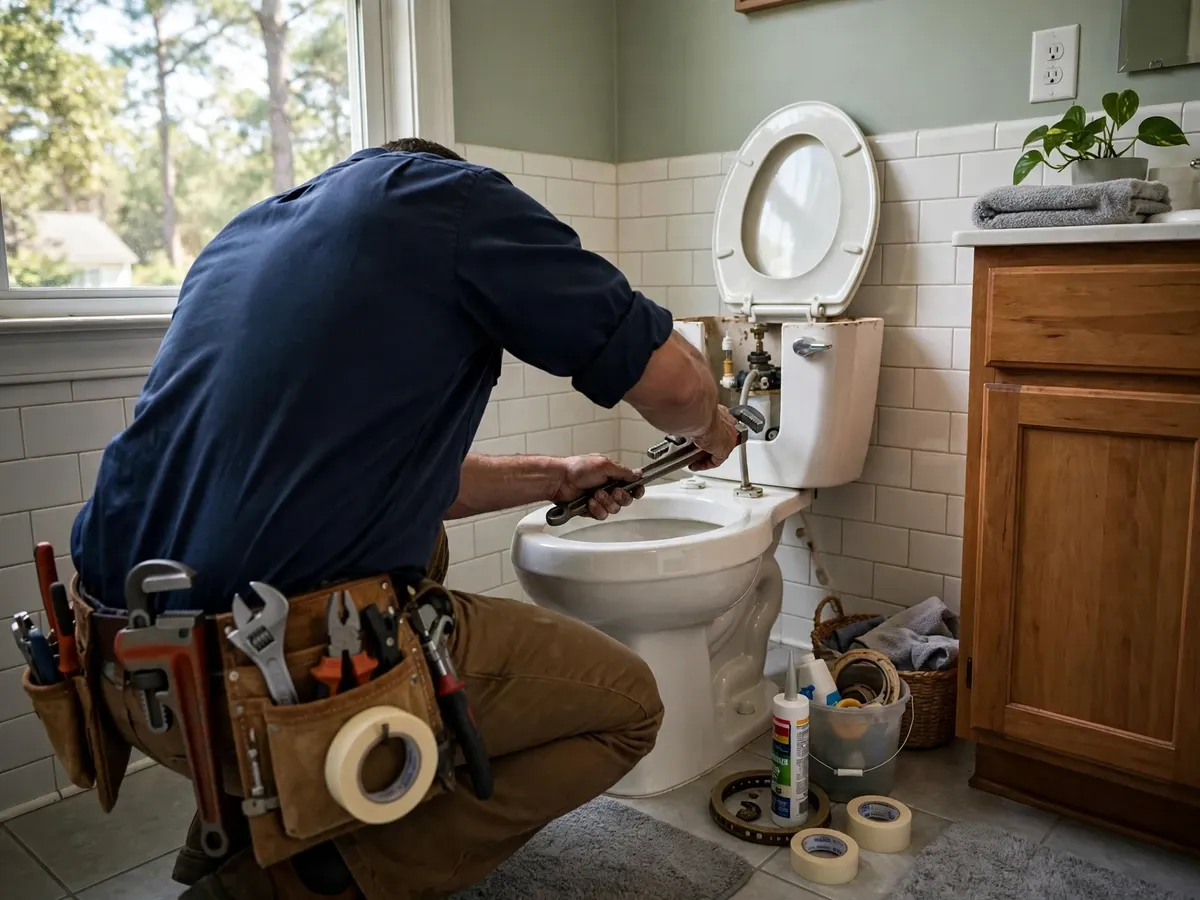
Stop the water before you do anything else
A toilet that will not flush and is filling toward the rim needs one thing right away: stop the water. Lift the tank lid and push the flapper closed, or turn the supply valve behind the toilet clockwise. Do not flush again. A second flush on a blocked toilet is how bathrooms flood.
Most clogs clear with a plunger. This guide covers the order of steps, when to stop and when to call. If water is overflowing or other fixtures are backing up, call the 24/7 line. See also toilet repair.
How to clear a clogged toilet
Work in this order.
- 1
Use the right plunger.
A flange plunger, which has a rubber extension, seals the toilet drain far better than a flat sink plunger.
- 2
Seat it and push gently.
Cover the drain opening, push slowly to avoid splashing and then pull sharply. Repeat several times.
- 3
Try hot water and soap.
Warm water with dish soap can help break up some clogs. Do not use boiling water, which can crack porcelain.
- 4
Use a closet auger.
A short auger made for toilets reaches the bend without scratching the bowl.
Never use a chemical cleaner in a clogged toilet. It makes a later plunging or cable job hazardous.
What the symptoms suggest
| Symptom | Likely cause | Action |
|---|---|---|
| One toilet clogged, others fine. | A local blockage. | Plunge, then auger. |
| Toilet clogs repeatedly. | Partial blockage or low flush power. | Call for a diagnosis. |
| Tub gurgles when toilet flushes. | Main line restriction. | Stop use and call. |
| Several fixtures slow. | Main line problem. | Main line cleaning. |
Toilet overflowing?
Close the supply valve and call. The 24/7 line is open.
Mistakes that turn a clog into a call
Flushing repeatedly, plunging with a sink plunger, using drain chemicals and prying at the toilet are the four most common mistakes. Flushing again adds water to a full bowl. A flat plunger does not seal, so you push air around instead of pressure. Chemicals create a hazard. Prying at the toilet can crack it or break the seal.
If a coat hanger or a stiff wire has been tried, mention it to the plumber, since a scratched trap is harder to clean and the object may have pushed the clog further in. A small wad of paper is a simple fix. Anything solid, like a toy, is a different story.
Keeping toilets flowing
A few habits lower the odds.
- Flush toilet paper only, in reasonable amounts.
- Skip wipes, even those labeled flushable.
- Keep a flange plunger in each bathroom.
- Fix a weak flush before it becomes a clog.
- Teach children what should never go in the toilet.
When the cause is not the toilet
If a toilet clogs repeatedly even after plunging, look beyond the bowl. A partial blockage in the drain line can cause the toilet to flush slowly and clog easily. A blocked vent stack can make a toilet gurgle and drain poorly because air cannot enter behind the water. Tree roots in the sewer lateral produce the same symptom, sometimes after years of slow buildup.
The key test is whether other fixtures react. If a shower gurgles when the toilet flushes, or a floor drain bubbles, the main line is involved. If only the toilet is affected, the blockage is likely between the toilet and the main line, or in the toilet itself.
When in doubt, call before the next flush. A plumber can run a camera or a cable and tell you what is going on. Repeated plunging on a line that needs a cable only delays the real fix and risks a backup into the house.
Protecting the floor while you work
Before plunging, lay towels or a plastic sheet around the base and keep a bucket and rubber gloves nearby. Plunge gently at first to avoid splashing. If the bowl is very full, remove some water with a cup before you start, so a successful plunge does not overflow the rim.
After the water drains, flush once, watching the level. If it rises toward the rim, close the supply valve and wait. Clean and disinfect the floor and the plunger afterward. If a toilet overflowed, dry the area well within a day to avoid damage to flooring and baseboards.
Roy, UT local note: pressure and scale
Roy City's 2024 water conservation plan describes delivery pressure of 60 to 90 psi in three zones. Pressure matters for toilets because the fill valve and the flush valve are built for a normal range. A toilet that flushes weakly can be a clog, but it can also be a pressure or a mineral problem.
Weber Basin lists hardness of 10 to 18 grains per gallon for its supply, and Roy blends sources. Scale in the rim jets can reduce flush power, and a weak flush clogs more easily. If you plunge successfully but the toilet clogs again soon, ask a plumber to look at the jets and trap. Nearby Ogden and Layton have the same water source.
Questions people ask
Yes. Its rubber extension fits the toilet drain and creates a tight seal, which is what makes plunging work.
If water keeps rising, if several fixtures back up or if plunging does nothing after several attempts, stop and call.
Yes. A toilet that clogs often, or fixtures gurgling together, can point to a main line issue. A camera look shows the cause. See sewer inspection.
It can contribute. Mineral scale in rim jets reduces flow, and Weber Basin water is hard. A vinegar soak can help, and a plumber can descale heavy buildup.