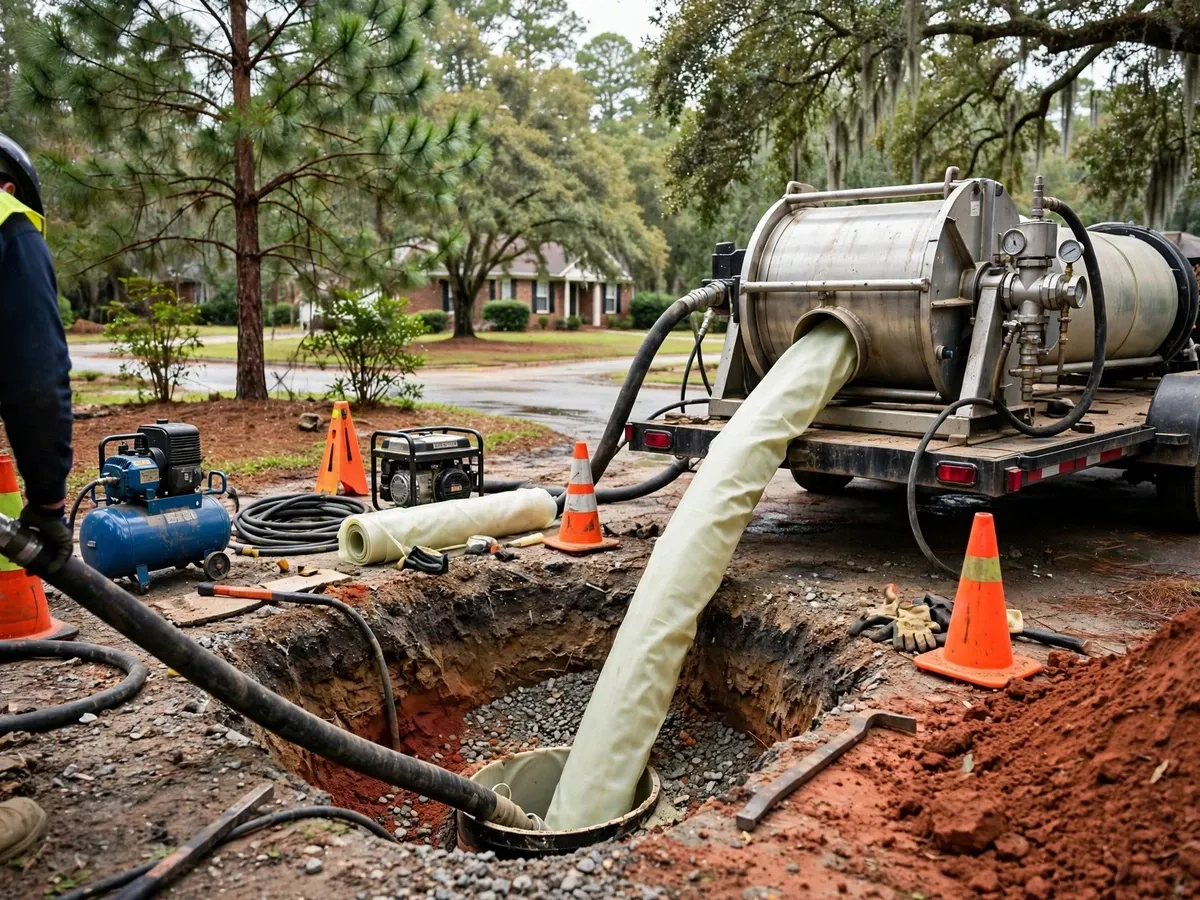
Lining a sewer pipe repairs it from the inside
Sewer pipe lining, often called cured-in-place pipe, puts a new pipe inside the old one. A flexible tube soaked in resin is pulled or inverted into the damaged line, inflated and cured so it hardens against the old pipe wall. The result is a smooth, joint-free pipe that seals cracks, stops root entry and does not need a long trench.
It is a repair method, not a miracle. It suits some damage and not others, and it starts with a camera. If sewage is backing up now, stop using water and call the 24/7 line. For the repair itself, see sewer line repair.
The lining process, step by step
The steps are the same for most residential jobs.
- 1
Camera inspection.
A camera inspection records the damage and measures the length and diameter of the line.
- 2
Cleaning.
The pipe is cleaned so the liner can bond. Roots are cut and scale is removed, often with jetting.
- 3
Liner installation.
The resin soaked liner is placed through an access point and expanded against the pipe wall.
- 4
Curing and reinstatement.
The liner cures with heat or light. Any side connections are reopened and the line is inspected again.
Lining compared with digging
Both work. The best choice depends on the damage.
Lining fits when
- The pipe is cracked, rooted or leaking at joints.
- The line is still round and continuous.
- Excavation would harm a driveway, patio or mature trees.
- You want fewer holes in the yard.
Digging fits when
- The pipe has collapsed.
- A deep belly holds water.
- A section is badly offset or missing.
- A short repair is cheaper than lining the whole run.
Repeat clogs in the same line?
Call and ask for a camera look before deciding on repair.
Signs a line might be a lining candidate
| What the camera shows | Lining a good fit? | Reason |
|---|---|---|
| Hairline cracks and open joints. | Often yes. | Liner seals them. |
| Roots entering at several joints. | Often yes. | Smooth liner keeps roots out. |
| Pipe collapsed or crushed. | Usually no. | Liner cannot pass through. |
| Large belly with standing water. | Usually no. | Liner follows the sag. |
| Several tight bends. | Depends. | Liner needs to pass the bends. |
A plumber reads the footage with you before recommending anything.
Questions to ask about a lining quote
Ask how long the liner is and how many access points are needed. Ask what material is used and what warranty applies in writing. Ask whether the line will be inspected again after the work and whether you get the recording. Ask what happens at each side connection, since those are common leak points.
Also ask who handles permits and inspections for your address. Lining and replacement may need a permit, and the plumber should know the local process. A contractor who is vague on these points is worth questioning.
What happens to the lawn, driveway and trees
The most common reason homeowners ask about lining is to avoid digging up the yard. A lining job usually needs one or two access holes, often at the cleanout or at the point where the line meets the house, and the rest of the work happens inside the pipe. A large tree that sits over the line, a patio or a driveway slab are the situations where this matters most.
Lining is not entirely excavation free. If a section is collapsed or badly offset, that section has to be dug and replaced first, and then the rest can be lined. A good contractor shows you on the camera footage exactly where each hole would go and why, so you are not surprised when machines arrive.
One more point is the lateral connection at the street. Lining the part on your property does not repair the public main, and the connection at the property line may be the responsibility of the city or sewer district. Ask the plumber where your responsibility ends and how the liner meets the connection.
Roy, UT local note: older laterals and permits
Roy City's 2024 water conservation plan describes its distribution mains as mostly PVC rather than metal, because of corrosive soil conditions. That is a statement about the city's mains. Private sewer laterals under your yard are separate, and older homes may still have clay or cast iron there, which is why a camera look is the first step.
Roy's growth from about 800 people in the early 1940s to about 24,600 by 1990, per the Utah History Encyclopedia, means many laterals are decades old. Permits in Roy are available through the city's online system, and the plumber can tell you what your repair needs. Neighbors in Ogden and Layton face similar aging lines.
Questions people ask
Manufacturers often cite lifespans of several decades under normal conditions. Actual life depends on installation quality, the host pipe and how the line is used. Ask for the written warranty.
Yes. The liner makes the pipe smooth, but grease or wipes can still clog it. Good habits and periodic cleaning still apply.
Slightly, because the liner has thickness. In most residential lines the loss is small and flow is often improved by the smoother surface.
Many can, if the pipe is still continuous. The camera shows whether it is. See sewer inspection.