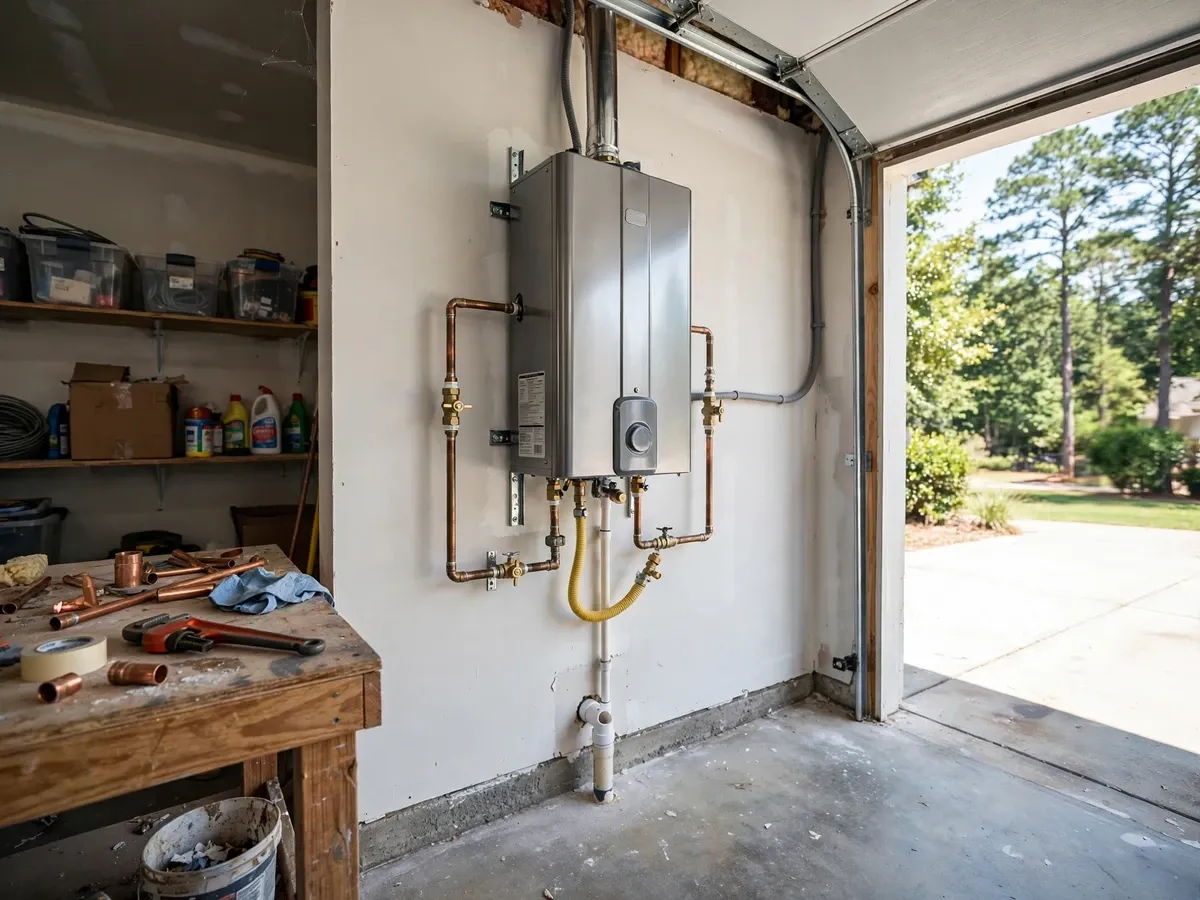
A tankless water heater heats water only when you use it
Instead of keeping forty or fifty gallons hot all day, a tankless unit fires up when a tap opens. It heats the water as it flows through a heat exchanger. The result is hot water that does not run out in the middle of a long shower, as long as the unit is sized for the demand.
Tankless is not the right answer for every home. It depends on the gas supply, the venting path and how much hot water you use at once. This page explains what to check, how the units fail and what maintenance keeps them running.
Questions that decide whether tankless fits your home
| Question | Why it matters |
|---|---|
| Is the gas line big enough? | Tankless units draw a lot of gas at once, and many older homes need a larger line. |
| Is there a venting path? | Special venting runs through a wall or roof, and the path has to be code compliant. |
| How much hot water do you run at once? | Several showers and a washer together set the flow rate you need. |
| What is the incoming water temperature? | Cold winter water lowers the output of any tankless unit. |
| Is the water hard? | Scale builds in the heat exchanger and calls for periodic flushing. |
An installer who skips these questions is guessing.
Curious about tankless?
Call and ask for an assessment of your home. A plumber can explain what it would take.
How a tankless installation goes
A tankless install has more steps than a tank swap because the infrastructure usually changes.
- 1
Assess the home.
The plumber checks gas capacity, venting options, electrical needs and the water supply.
- 2
Plan upgrades.
If the gas line or venting needs changes, you hear what they involve and the clear price before work begins.
- 3
Remove and install.
The old tank is removed and the tankless unit is mounted, vented, connected and commissioned.
- 4
Program and test.
The plumber sets temperature, tests flow and shows you maintenance points like the service valves.
Tankless against a tank in everyday life
Neither type wins on every measure.
Tankless
- Continuous hot water in normal use.
- Smaller wall footprint.
- Usually costs more to install.
- Needs scale flushing in hard water.
Tank
- Simple, familiar installation.
- Lower upfront cost.
- Can run out in long use.
- Wastes standby heat.
Hard water and tankless units in Roy
Weber Basin reports hardness of 10 to 18 grains per gallon for the water it supplies to Roy and neighboring cities. In a tankless unit, scale builds in the narrow passages of the heat exchanger and reduces flow, triggers error codes and can shorten the unit's life. A flush with a descaling solution through the service valves, done on a schedule, helps a great deal.
Roy's water plan reports delivery pressure in the 60 to 90 psi range. Tankless units need adequate flow to fire, and high pressure is generally not a problem for them, though a pressure reducing valve is still good practice. If you notice the unit shuts off at low flow, tell the plumber, since that pattern has a specific fix.
Keeping a tankless unit healthy
Maintenance is what separates a long-lived unit from a short-lived one.
- Flush the heat exchanger on a schedule suited to your water.
- Clean the inlet filter screen.
- Check the vent for blockage or damage.
- Look for error codes and write them down for the plumber.
- Consider a softener if scale is heavy, see water softeners.
What decides the price of a tankless job
Insurance does not cover the upgrade itself. A failed unit that floods a room may fall under a sudden-damage claim.
When to call right away about a tankless unit
Most tankless problems are not emergencies. These are.
- You smell natural gas, so leave the building and call the gas utility or 911 first.
- A carbon monoxide alarm sounds, so get everyone outside and call 911.
- Water is leaking from the unit or its connections.
- The unit shuts down repeatedly with the same error code.
- You see scorching, soot or melted vent parts.
Do not reset a unit repeatedly in an attempt to clear a safety shutdown.
Related water heater help
If you decide a tank suits your house better, the installation page covers planned tank work, and a failing unit of either type is handled under water heater repair. Scale is the main enemy of tankless units, so water softeners are worth a look, especially for homes in West Haven.
Questions about tankless water heater
It runs out of capacity rather than volume. If demand exceeds the unit's flow rate, the temperature drops. Proper sizing prevents that.
Yes. Error codes, scale, ignition and sensor problems are common repairs. The plumber reads the code and tests the cause.
In hard water, yes. A flush on a regular schedule keeps scale from building up in the heat exchanger.
Usually a larger gas line, new venting and possibly a condensate drain or electrical connection. The plumber checks and tells you the steps and the price before starting.